
A Goblin, A Suitcase, And A Dream
You are a dice roll away from a totally different fortune—the goblins are sure of that.
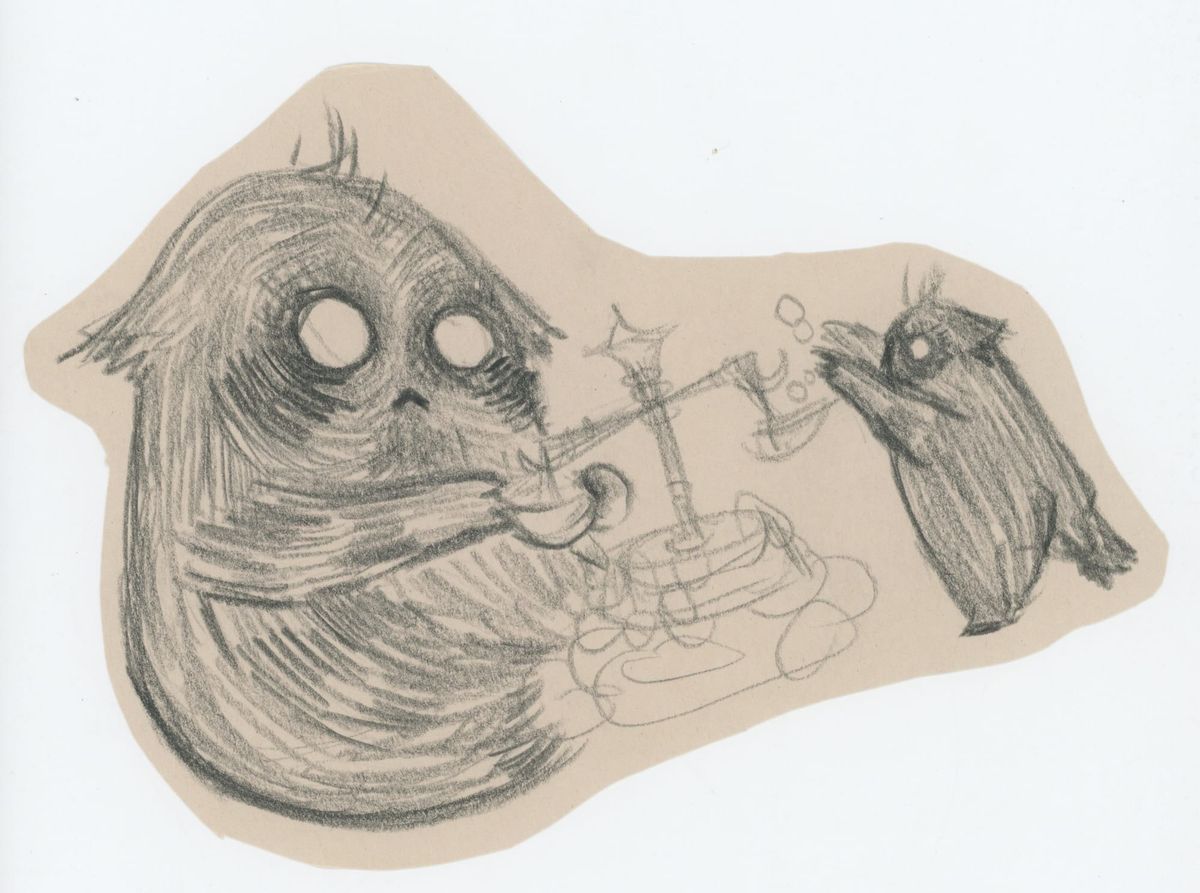
“Come buy,” call the goblins
Hobbling down the glen.
I have routinely told people that all goblins can run their own goblin market as long as they adhere to the values of goblinhood. It was somewhat of an open-source approach, and later, I was struck by a sense of dread. I worry about maintenance and the life of this project beyond my involvement. This is the dread I feel for the arts and culture, and for all the precious things we experience in life at large that can't simply be passed on through mere copy-pasta. What are the values of goblinhood? The answer lies in asking important questions in inconspicuous and mischevious ways.
One of the founding goblins, Amelia Winger-Bearskin, took the goblinhood to Watershed in Bristol, UK. Read more here.
Artsite Railway Warehouse in Hsinchu, Taiwan, created its own rendition, inviting people to show up with their own interpretations of what is precious to them.
Goblin Market, Halifax, here in Canada, is about to start, with a side of how fortune can't really be predicted and that you don't always get what you wanted.
It's a busy time for the goblins.
*
The Halifax Iteration
Categories, predictions, backups, and fortune came up frequently over the past months while working with the Centre for Art Tapes as we shape the themes underpinning this iteration of Goblin Market. As much as predictions and backups can offer a degree of certainty, fortune is always just a dice roll away.
When taste becomes a trending keyword and beauty becomes one of the things that everyone bet on to be the antidote to AI-generated abominations, there are a couple of things I find hard to resolve. The difference between beauty defined by moral goodness and by aesthetic quality. Neither feels sufficient, and both reflect the tastes and values of those with access to a world walled off by class. There’s a third definition: beauty as measurement and measurability. There’s something distinctly scientific about this way of describing beauty, yet its rationality feels deeply uncanny. More categories for how things will be measured will be met with more exceptions, and who makes up these categories and subsequently decides on the exceptions?
Before the printing press was popularized, authors would have been delighted to know that another copy of their book had been made by someone else without their involvement. Producing a book was labourious and expensive. It would’ve been a good deal for authors if somebody else had made another copy of their book for them. Indeed, you wouldn't want the sole copy of your work to be lost to misfortune without any backups. When the printing press made reproduction significantly cheaper and more efficient, sloppier copies of books full of mistakes and information that may not be truthful at all followed. “Another copy” stopped being a good deal for authors with this new technology, with its infinite possibilities for backups and, on the flip side, the mutations and pre-digital slop. What we got out of it was the beginning of copyright, which the author could benefit from if they disseminate their work through a publisher or bookseller, akin to platforms we are familiar with—Amazon, Spotify, Netflix, and so on. You might see where this is going. We seem to persistently offload our cultural reproductions and backups in ways that take power away from us. Certainty is a salt circle that simultaneously keeps things out and traps things in.
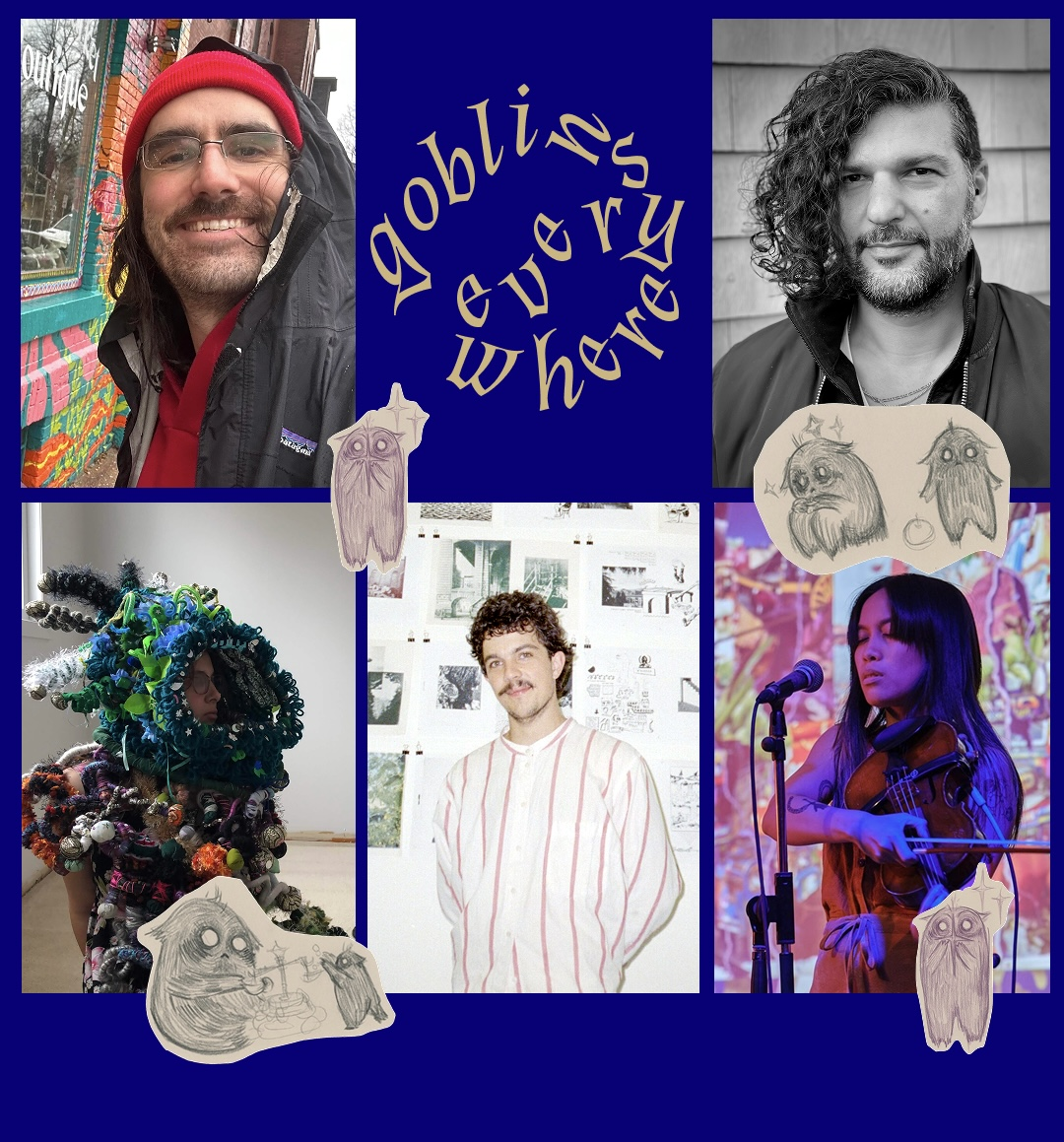
Over the past two months, we at UKAI Projects worked with the Centre for Art Tapes and a cohort of Halifax goblins on this thematic throughline. For this Halifax rendition, we opted for a lottery selection process with very little curatorial interference in who gets to be part of the group. They are: Ufuk Gueray, Marcus Dénommé, Julie Dyer, Evan Cameron, Charity Cruz, and Lou Campbell. A strange and lovely bunch. The ideas of categories. The idea of backup. The idea of somehow becoming resilient to the planting of false memories. How do you tell if a memory was real? How do you create a backup of something that can’t be translated into data? What cultures get preserved in this long game of exquisite corpse, and who benefits from it when artists and cultural workers rarely capture the cultural capital they produce? If this cultural capital isn’t measured through economic benefits, then what is it?
Over the course of the program, we learned about everyone’s practice in meandering ways and gained new perspectives on the chronic under-resourcing of arts and culture, and perhaps that under-resourcing isn’t what it seems. The format is also open-ended, as the artists bring their relationships to the showcase, where meaning accumulates and evolves as audiences thread their experiences together in their exchanges with the goblin merchants—the trinket economy, if you will.
The allure of the trinket economy that emerged in past renditions reveals a side of the under-resourcing problem the arts face. Art reproduces what sustains culture, yet is valuable to our lived experiences and decommodified within an economic structure that prioritizes economic growth. Goblin Market, the poem itself, is a reflection on this exact logic, in which the feminine reproduces what sustains the labour force, from biological reproduction to house chores to emotional care, while excluded from what is considered “work work” that performs economic value, as what the goblin men do? What is an equal exchange, then, if the work that arts and culture do doesn’t measure the same way as what’s considered productive? In making such a demand, for example, to be paid, does it make the nature of the “uncommodified work” lose its purity or moral goodness?
We saw A24 striking a deal with Google DeepMind. The Internet was disappointed that they accepted evil AI money, despite the framing that this injection of money was for developing new tools rather than for direct interference with content. I’m curious about what cultural capital Google accumulates when it chooses to invest in film and entertainment, and, subsequently, how corporations at Google's scale shift cultural production and meaning-making at large. Why are we so mad?
Being a goblin in this case means that we must find a new way of inhabiting the ruins of this economy all while bursting the bubbles with joy. Challenging the idea of purity in what artists should do, or how artists should engage with the broader landscape of capitalism.
One of the reasons Goblin Market operates through travelling is that I wanted a different use for the residency format that has increasingly been co-opted into vacations with a side of ego boost. The Summer Residency wreck, where an unrealistic number of artists have been accepted into a residency (and subsequently been ghosted by the organizers) with terms too good to be true upon paying an application fee of $25 each, revealed a growing chain of toxic culture: artists moving from one residency to another while being profited off the desire to be seen by those upstream. Better when it is funders or institutional presenters than scammers. However, our own downfall lies in the mismatch between what we value from an artistic and creative experience. Residencies are a part of the arts ecosystem that can be generative, but what artists get out of it greatly varies. A good outcome is a concerted effort from all that take part.
Here are the questions:
What do artists actually benefit from through residencies? Can we produce these conditions within our existing networks and with the resources we have?
Space, time, materials, mutual support, and a gathering of diverse perspectives are among the first things that come to mind. Next would be a showcase or exhibition, a chance for interesting ideas to meet the world. Where this showcasing differs from a spectator-oriented exhibition format is that this "market" is itself a performance that pulls people into creating art as meaning-making. It forces the visitors to engage with models of the world different from their own, through questions posed by artists.
Art is a way of seeing the world beyond the categories assigned to objects, many of which predate us. We don’t question these pre-made categories because, more often than not, they are part of the common language that makes our lives easier.
Take money, for example, there aren’t many ways it relates to funding an art project:
- their money, my/our project
- my/our money, my/our project
- my/our money, their project
- their money, their project, I/we manage
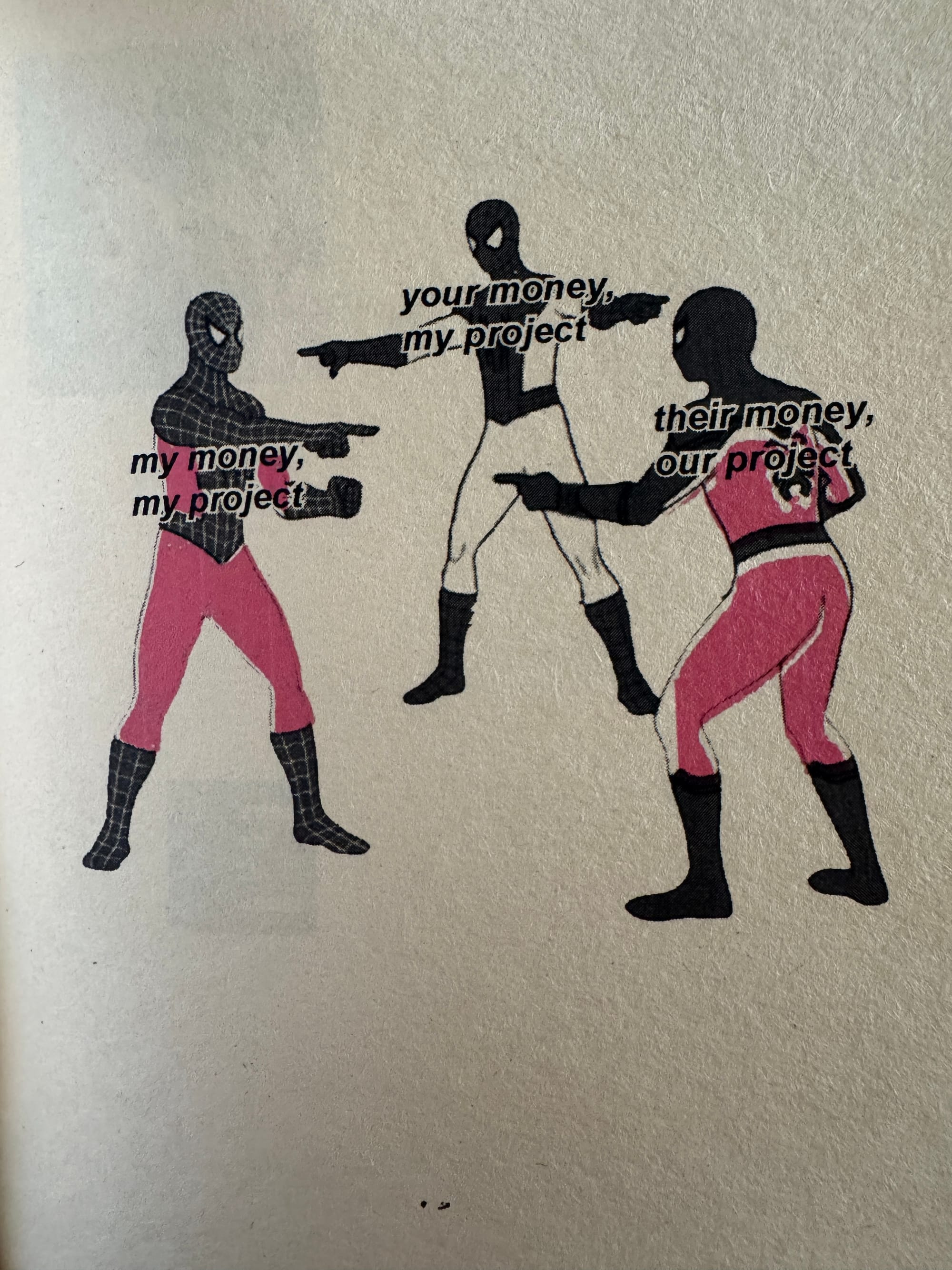
At the end of the day, there’s no correlation between this "whose money" list and the value produced through a project. I personally find "their money, my/our project" being the most ego-boosting. People don’t pay for the project: they pay for a secret third thing: self-worth, perspectives, perception, commitment to the bit, or simply a good time. Whether it is a safe container for committing to the bit, a way to realize some sense of self-worth outside of productivity, or a desire for something you don’t currently have, value is never just a number. An art project about money questions not only the money itself but also the power money brings, which stands between artists and their works. In my view, I want Goblin Market to play a role in sequestering the power associated with arts funding by making infrastructure an artistic and creative endeavour. In other words, a system within which artists capture the benefit of the cultural capital they produce/reproduce.
Under-resourcing in the arts is more of an absence of attention to what we consider valuable and a lack in the infrastructure we need for resources to reach the non-maximized parts of social life.
Does art need a reason to exist? I don’t think so, just as we don’t need a reason to desire something beautiful and whimsical. However, art doesn’t always present itself as a solution to modern problems, especially when the pool of answers we tend to gravitate towards is optimization and maximization. When seeking solutions, we often look to the same places for answers rather than shifting our gaze elsewhere.
I thought about what artist Lin Chun-ta, who took part in the Hsinchu Goblin Market, told me about an elderly person who spent a long time deciding what to give in exchange for an “inspirations” cookie (which was part of the artwork he brought to GM), presumably went back home, and returned with a small cup. Was the long, contemplative decision-making to weigh the appropriateness of this exchange? We’ll never know. However, what is of equal value to an inspiration?
I also thought about how much I value a “good exchange” in terms of whether what I received was useful, even when the “use” wasn’t assigned. I have been using an old camping burner as an incense holder for ten to fifteen years now. It’s not aesthetically aligned with “incense burning” in any shape or form, seen online or in other curated images, but for some reason, I use it the most.
With the “travelling merchant” bit of Goblin Market, perhaps the most valuable lesson is that we will always have to find ways to use things for purposes other than their prescribed use. It’s one thing to be able to quote metaphysics on an object’s “identity.” It’s another thing to unlearn what a garbage can is and the contexts in which it is useful.
*
I had the memory of a chain of emails for rescheduling a meeting from morning to afternoon. I was sure of it. Then, when morning came, I discovered that this chain of emails never happened. There was no trace of it at all. I must have had a weirdly realistic dream, or perhaps dipped into a parallel universe momentarily.
How disappointing, I was dreaming of emails when I should’ve been simply asleep.
*
Last call: If you are in Halifax June 26 & 27, consider hobbling down the glen with the goblins and make a worthwile exchange at the Goblin Market.